
Microjet Irrigation
Microjet irrigation delivers water where it's actually needed — and makes it easy to confirm it's working.
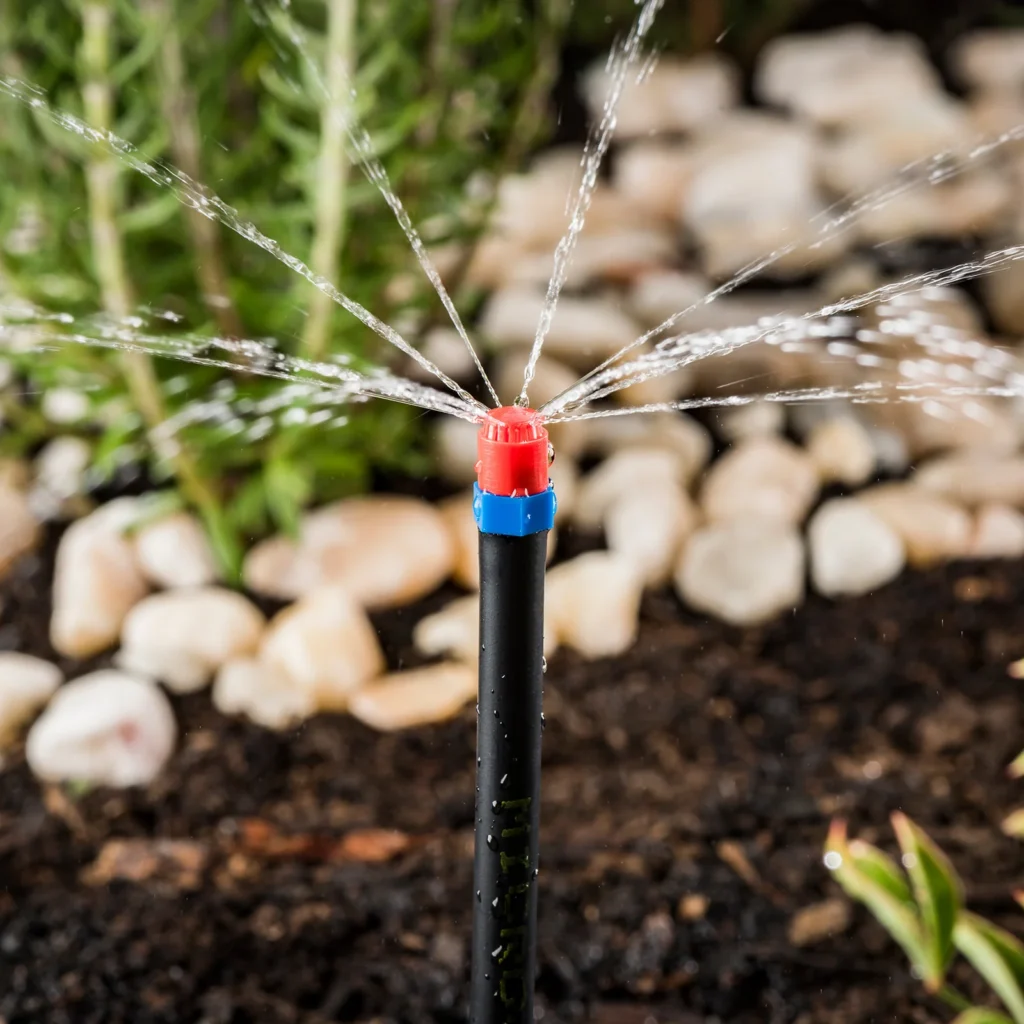
Irrigation is not a separate feature of a landscape. It is the delivery system that determines whether plants and flowers thrive or slowly decline.
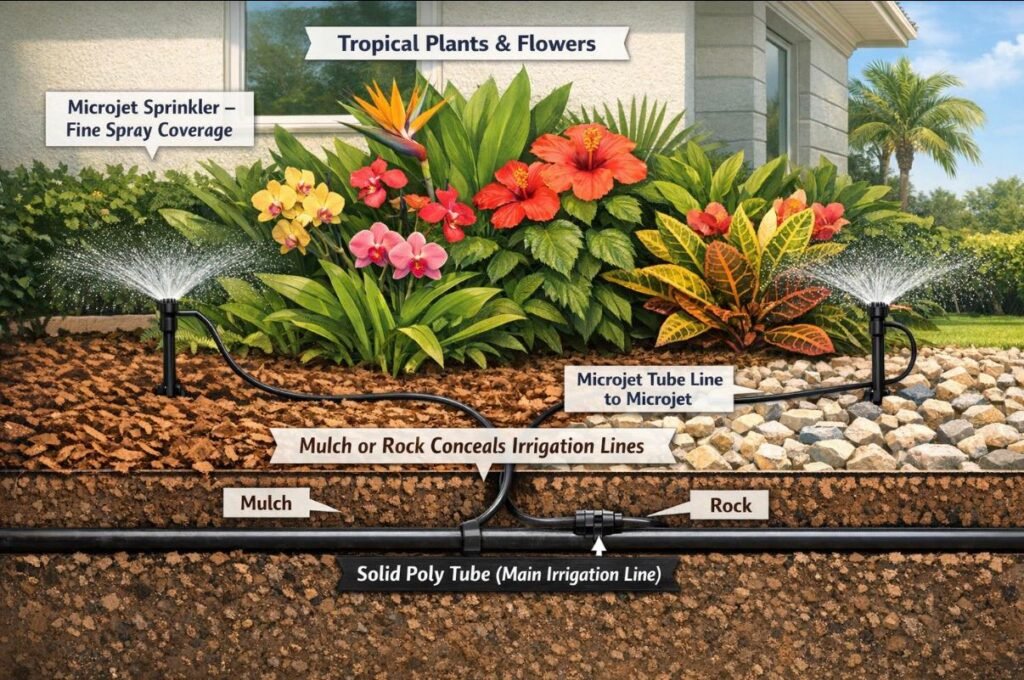
Recognizing the Signs Your Irrigation System Is Underperforming
Hidden Failures
Drip emitters fail under mulch with no visible indication until plants show stress weeks later.
Dry Pockets in Beds
Plants browning at the edges while others look fine — classic drip line coverage gaps in sandy soil.
System Outlived the Landscape
Original drip layout made sense for the install — but plants grew, beds expanded, the system didn’t adapt.
Uneven Growth
Shrub clusters growing unevenly often trace back to inconsistent root zone moisture, not soil or sunlight.
What Is Microjet Irrigation?
Precision Spray.
Broader Coverage.
Visible Performance.
Unlike drip lines that deliver water at fixed points along buried tubing, microjet systems use small stake-mounted emitters to spray water outward in a controlled radial pattern — covering the full root zone of clustered planting beds, not just a narrow strip.The result: a system safe enough to run through planting beds and mulch, efficient enough to cost less than a few indoor bulbs per night, and flexible enough to grow with your landscape.
The biggest practical advantage: you can see it working. Every zone can be visually confirmed during operation, making maintenance faster and failures obvious before they cost you plants.
Radial spray pattern — even root-zone coverage across the full bed footprint
Microjet vs. Drip Line
Why Drip Line Falls Short in Florida Landscapes
Drip systems work well in uniform, linear planting rows. Florida tropical landscapes — with clustered beds, mixed densities, and sandy soils — introduce variables that expose drip’s limitations.
Stop Guessing If Your Plants Are Getting Enough Water
Kompanion Lawn Care offers a structured irrigation assessment to evaluate whether microjet is right for your property — no commitment required.
How It’s Done
The Kompanion Lawn Care
Microjet Irrigation Installation Process
Microjet systems are engineered to the property — not dropped in generically. Here’s what every installation involves.
01
Site Evaluation
Soil composition, plant maturity, bed geometry, sun exposure, and existing infrastructure assessed before any work begins.
02
Flow & Pressure Check
Microjets require controlled pressure. We verify and regulate operating pressure to ensure consistent output across all zones.
03
Plant Grouping Map
We map actual cluster groupings and anchor palms to determine where water should go — not just where tubing already exists.
04
Emitter Selection
Emitter type and spacing chosen based on spray radius and root zone coverage — not visual symmetry or installer convenience.
05
Installation
Regulated supply lines, microtubing, and stake-mounted emitters installed with secure connections. Lines flushed, zones balanced.
06
Commissioning & Test
Every zone activated and observed. Spray radius and angle adjusted to confirm uniform coverage with no overspray onto hardscape.
Built for Florida Landscapes
Why Standard Irrigation Advice Doesn't Apply Here
Florida’s climate, soil profile, and tropical planting culture create specific irrigation challenges that most generalist contractors don’t account for.
Sandy Soil
Behavior
Water moves downward quickly with minimal lateral spread. Systems designed for clay soils often leave roots dry in Florida landscapes.
Tropical Planting Style
Clustered tropical beds, densities, and anchor palms require radial coverage, not linear drip layouts used in new construction.
Heat & Evaporation Load
Florida summers demand consistent, even moisture delivery. Inconsistent systems show failure fast when heat stress compounds irrigation gaps.
Serviceability Matters
For maintenance-focused companies, visual confirmation of every zone is non-negotiable. Invisible drip failures cost time and plant replacements.
Smart Watering Starts Here
Common Questions About Keeping Water Away From Your Home
Is microjet better than drip irrigation in Florida?
In our experience, yes — particularly in Florida residential landscapes.
Drip irrigation delivers water at concealed, fixed points beneath mulch. In sandy soils, water moves primarily downward, making it difficult to visually confirm coverage. When emitters clog or lines become restricted, plant stress may not appear until damage is already developing. Troubleshooting can be time-consuming and disruptive.
Microjet systems provide visible spray across a broader surface area. Coverage can be observed immediately during testing, adjustments are straightforward, and performance issues are easier to identify early.
While drip systems are commonly installed by default, we have found microjet irrigation to be more reliable, more serviceable, and better aligned with structured tropical landscapes in South Shore Tampa Bay.
How much does microjet irrigation installation cost?
Cost varies based on bed size, zone count, existing infrastructure, and whether conversion from drip is involved. A structured site evaluation provides accurate scope and pricing.
Can you convert my existing drip system?
Yes. Many conversions involve repurposing existing supply lines and installing microjet emitters to improve coverage. Each property is evaluated individually.
Does microjet waste more water?
No. When properly designed and regulated, microjet systems deliver water at low pressure with controlled output — but over a shorter runtime.
Traditional drip systems are often programmed for extended cycles, sometimes 30–40 minutes, to compensate for limited lateral movement in sandy soils. Microjet systems typically operate in shorter cycles — often around 8–12 minutes — delivering water more evenly across the intended root zone without requiring prolonged saturation.
Rather than slowly soaking a narrow strip for an extended period, microjets apply water across a defined surface area and allow it to infiltrate naturally. Efficiency is achieved through correct zoning, runtime calibration, and coverage design.
How long does installation take?
Most residential irrigation upgrades or installations are completed within one day.
How often should irrigation systems be adjusted?
Every irrigation system should be equipped with a functioning rain sensor. When properly installed and maintained, the rain sensor automatically prevents the system from running when adequate rainfall has occurred.
In the Tampa Bay area, this means seasonal “adjustments” are typically minimal. During extended rainy periods, the sensor manages shutoff automatically. During peak summer heat, runtimes remain consistent to support active growth.
The only common manual adjustment is a slight reduction during prolonged cold spells when plant demand temporarily decreases.
A properly designed and regulated system should not require constant reprogramming.
Find a Kompanion Lawn Care Microjet Irrigation Installer in Your Area
Landscape lighting is available through Kompanion’s network of certified local installers. Enter your zip code to find the location nearest you and schedule a property lighting evaluation.